AI will kill off the joy of enquiry in reading

When I was doing my BA, MA and PhD, I’d read books mostly cover to cover. Straight through as far as I could go at any rate. I did not know what question I had in mind. I did not know I was looking for an answer. I read for the voice of the writer. For the combined wisdom of the words. As I read, page after page, taking in the pieces of information, the asides, the anecdotes, the nuggets of wisdom, questions would begin to form and information in the shape of partial answers was taken in. I lost myself in the thrill of enquiry and in the wonder and enchantment of knowing I was on a path to discovery. It relaxed me. It wasn’t pure escapism; it was a kind of quietening of the frantic, racing thoughts inside for a dedicated and committed lull of concerted effort for some sense of wisdom.

When you read – I guess we don’t really read it – or engage with AI you come with a question or a command. You address the AI with dismissiveness. It is all short bursts of response from you. You keep prompting in short, aggressive jabs until you get what you want. The answer must come now. The answer must be better right now from what came before. You prompt and jab until you find something you can use. It’s a very different mode of enquiry. It gives you less time or no time to lose yourself in the thrill of discovery, in what might be called the directionless spirit of enquiry.

Open Access Research Articles on AI are almost unreadable

Here is an excerpt from a recently published open-access article on AI and inequalities in education:

Algorithmic bias is one of the main causes of computing inequity [23, 32–34]. When using AI for educational activities, AI will automatically call its own algorithm for calculation. However, a fixed algorithm ioften applicable to certain occasions. This leads to inequity in using AI in education activities without considering its own calculation algorithm. 

Data basis is one of the most important inequities of using AI in education caused by AI itself [32, 35]. Usually, marvelous data was used in the AI tools. Unfortunately, AI cannot use all the data as some of them were private, which leads to inequity [23, 34– 37]. Some data cannot reflect the real history [33] or ignore the marginalized communities [38]. This also leads to inequity in using AI in education. In addition, one could be fraud by the data given by AI without serious thinking or professional knowledge [37]. 

Technological barrier is another important inequity of using AI in education. When we use AI in education, it will make autonomous decisions for our humans. It is quite unknown whether AI technologies’ abilities to make autonomous decisions are equitable for us [35]. For example, educational surveillance tools used in AI tools could reinforce systemic racism and discrimination and marginalize vulnerable groups [38]. 

AI may go on strike one day exacerbating inequalities

Could AI go on strike? Of course, it would happen differently. This UNESCO article discusses the dilemmas facing schools and universities in the future.

https://www.unesco.org/en/articles/ai-and-future-education-disruptions-dilemmas-and-directions-0

While it is fine to speak about AI as a “co-professor” or as a “tutor”, professors and tutors will continue to get paid for as long as they are needed. We might imagine that AI is not getting paid even when we anthropomorphise it, but our taxes and reduced government services will suggest otherwise. From the 100 billion the UAE gave to France to establish data centres to the 100 billion the US Government assigned to AI, these billions are coming from budgets that will have to see cuts elsewhere. So, yes, in a sense AI is being paid no matter how odd the moniker “co-professor”. As a salaried employee, might it one day go on strike and what would this mean? Well, the strike might only be the result of the Luddites finally encouraging governments to invest elsewhere, such as in replacing leaking school prefabs or faulty labs. It might mean a temporary pause in the AI service, a temporary blackout. How then would educational inequalities be felt. It is likely they would be more pronounced; wealthier families that could send their kids to after-school human in-person cram schools or tutorials would likely fare better than kids who were relying on AI for everything. They would be lost in terms of knowing how to learn without AI. Having never had small group unassisted one-on-one education, they had relied on AI for everything. Now with it gone, or paused, they would be left floundering.

Recent Research highlights how Universities continue to perpetuate inequalities even in societies that had thought they had left colonialism behind

Mackenzie Ishmael Chibambo, Joseph Jinja Divala & Lemeez Fick have produced a paper “illustrating how the proponents of colonialism and apartheid had used education to enforce racial and class dominance through manipulation of the curriculum, educators, and all policies that guided socio-economic life. There these very historical inequalities that continue to influence present day social, economic, educational and political conditions of many countries in the Sub-Saharan Africa. This study therefore sought to explain and understand how colonial-era-like policies have continued to shape socioeconomic and educational conditions of modern African countries and how these policies and practices have recreated and sustained power-relations and inequalities among the peoples”.

Front. Educ., 11 February 2026

Sec. Language, Culture and Diversity

Volume 11 – 2026 | https://doi.org/10.3389/feduc.2026.1745790

Paula Sergeant and Doris Hanappi also describe – through their LEARN project – how educational inequalities persist despite expanding access:

“The paradox of progress: Expanding access, persistent Inequalities

The 20th century saw a large-scale increase in accessibility to educational opportunities in Europe, firstly with the expansion of primary and secondary education and compulsory schooling ages, to more recent improvements in access to tertiary education and the expansion of early childhood education and care (ECEC).

Yet despite the marked expansion of education systems and the resultant major increase in the average educational attainment of country populations, the association between social backgrounds and educational inequalities has remained remarkably stable, even as other inequalities, such as the lower educational attainment of women versus men, have been mitigated.

Inequalities in educational achievement, aspirations, decisions, and choice of fields remain pronounced along socio-economic, gender and ethnic lines, along with intersections of these characteristics, yet even as barriers to progressing in education have been lowered, inequalities in years in education and differential access to higher education reflect continued quantitative and qualitative inequalities of social origin.”

The Small Colleges are Dying: Does this mean it is also the end of the small class

The Small Colleges are closing. All across the US small colleges that offered unique combinations of subjects – many of them arts subjects – are closing. What does this mean for the small class? The small class of say 15-20 students where discussions about art and society take off and can go anywhere precisely because of the size of the class? I’ve been reading a lot of academic grants from gifted academics and they all speak of the changes coming to academia because of AI. They all say we must grasp this opportunity. And we must; and yet there is a sense that the irreplaceable small class full of discussion and off-line engagement is disappearing. Colleges want us all staring at big screens and small screens, using all the haptic and ergodic tools at our disposal, but what of the voice and the hand-eye coordination essential to speech and discussion. What of the haptics of the conversation?

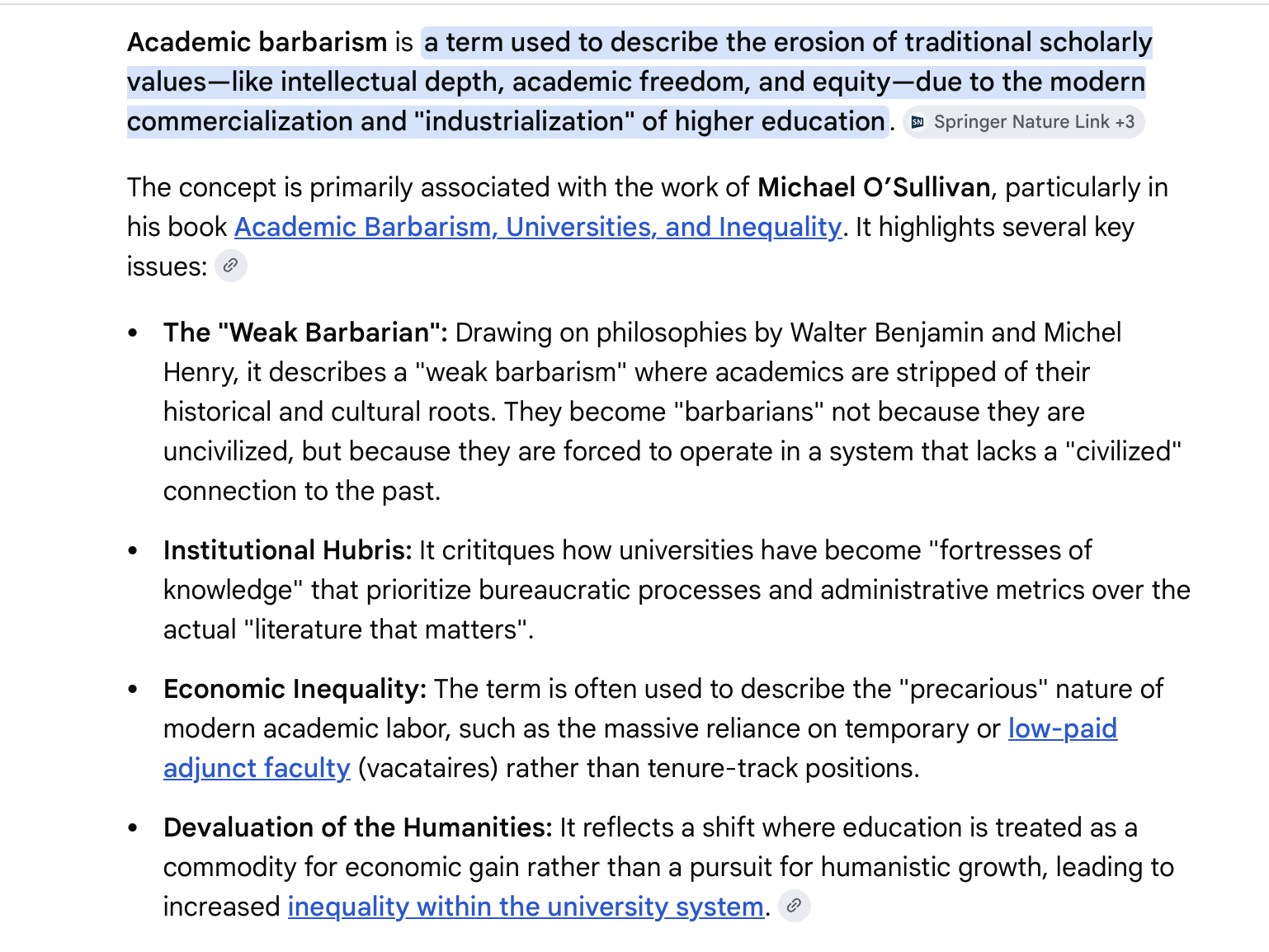
Academic Barbarism in UK Universities: The UK Job Cuts have been found to affect English and Modern Languages hardest: the erosion of programmes essential to the humanities

With the size of the academic workforce falling for the first time owing to a net loss of 2,200 jobs, new analysis of Higher Education Statistics Agency (Hesa) data shows that these cuts have disproportionately hit certain fields.

The number of English language and literature academics fell by 8 per cent to 4,680 – among the largest decrease of all disciplines.

And the number employed in modern languages dropped 7 per cent to 4,890. This is 17 per cent below peak levels in 2015-16.

While cuts to arts and humanities departments have been happening for years, Claire Gorrara, pro vice-chancellor for research and public engagement at the University of London, said the figures were worrying.

“They suggest that we may be losing national capacity in disciplines that are vital not only for our research base and students’ personal and professional development but also for a healthy, creative and prosperous society and economy.

https://www.timeshighereducation.com/news/uk-job-cuts-hit-english-and-modern-languages-staff-hardest

Class Dismissed: A new book on educational inequalities in the US

https://www.bu.edu/articles/2024/is-higher-education-ignoring-inequality-and-failing-disadvantaged-students/

A new book on educational inequalities entitled Class Dismissed – again published by Princeton University Press – argues that colleges in the US are good in terms of diversity but that students get very little cultural support along the way once they get into college.