Recent Research highlights how Universities continue to perpetuate inequalities even in societies that had thought they had left colonialism behind

Mackenzie Ishmael Chibambo, Joseph Jinja Divala & Lemeez Fick have produced a paper “illustrating how the proponents of colonialism and apartheid had used education to enforce racial and class dominance through manipulation of the curriculum, educators, and all policies that guided socio-economic life. There these very historical inequalities that continue to influence present day social, economic, educational and political conditions of many countries in the Sub-Saharan Africa. This study therefore sought to explain and understand how colonial-era-like policies have continued to shape socioeconomic and educational conditions of modern African countries and how these policies and practices have recreated and sustained power-relations and inequalities among the peoples”.

Front. Educ., 11 February 2026

Sec. Language, Culture and Diversity

Volume 11 – 2026 | https://doi.org/10.3389/feduc.2026.1745790

Paula Sergeant and Doris Hanappi also describe – through their LEARN project – how educational inequalities persist despite expanding access:

“The paradox of progress: Expanding access, persistent Inequalities

The 20th century saw a large-scale increase in accessibility to educational opportunities in Europe, firstly with the expansion of primary and secondary education and compulsory schooling ages, to more recent improvements in access to tertiary education and the expansion of early childhood education and care (ECEC).

Yet despite the marked expansion of education systems and the resultant major increase in the average educational attainment of country populations, the association between social backgrounds and educational inequalities has remained remarkably stable, even as other inequalities, such as the lower educational attainment of women versus men, have been mitigated.

Inequalities in educational achievement, aspirations, decisions, and choice of fields remain pronounced along socio-economic, gender and ethnic lines, along with intersections of these characteristics, yet even as barriers to progressing in education have been lowered, inequalities in years in education and differential access to higher education reflect continued quantitative and qualitative inequalities of social origin.”
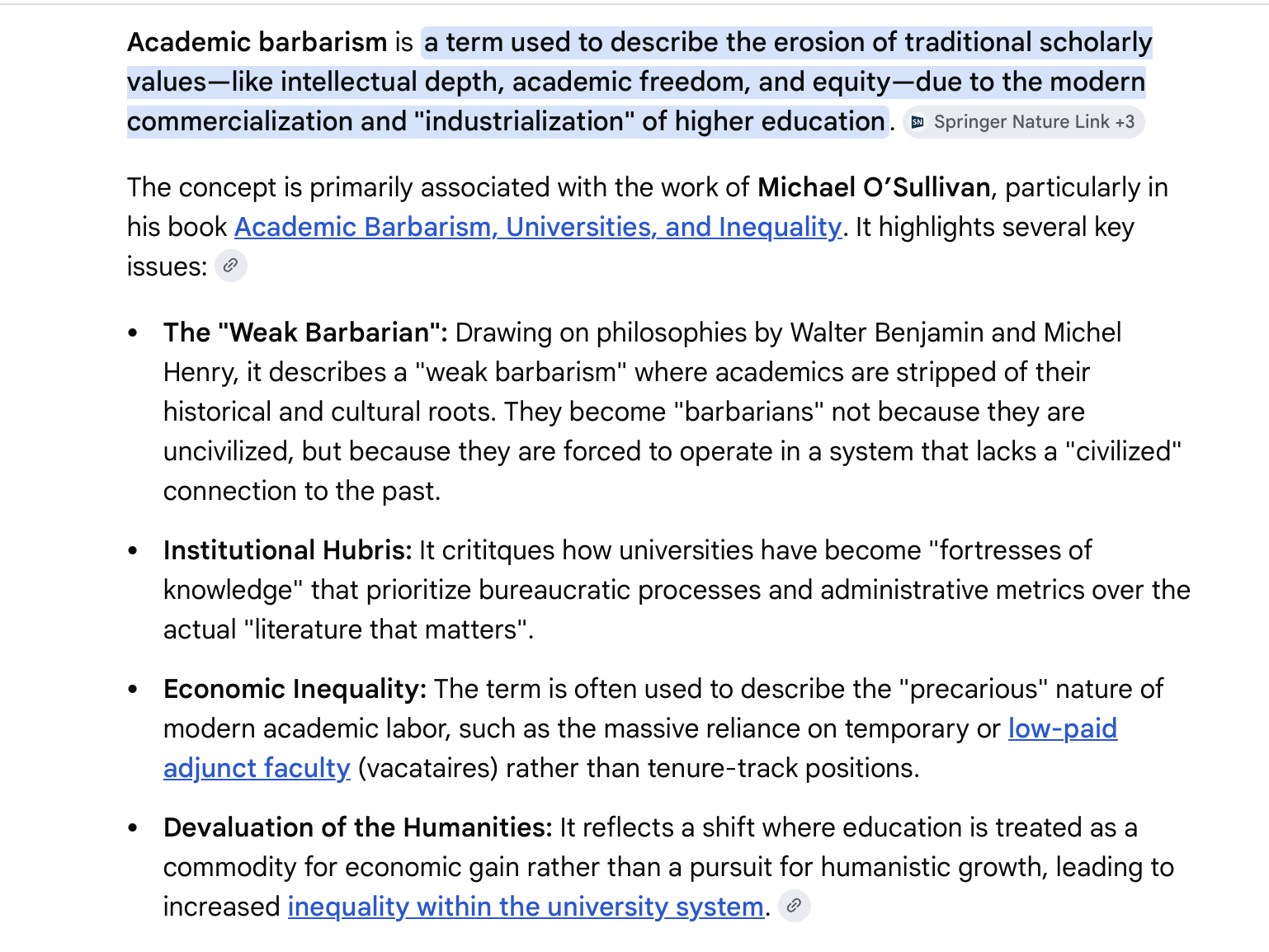
Academic Barbarism Acknowledged by AI as the Core Problem of Universities

In 2016 I coined the term “academic barbarism” in my book Academic Barbarism to describe the vast university complex perpetuates inequalities in society. 10 years on it is now interesting to see how AI describes the term. It seems to be recognised as core problem now of the university complex. Here is just one AI response:

The Small Colleges are Dying: Does this mean it is also the end of the small class

The Small Colleges are closing. All across the US small colleges that offered unique combinations of subjects – many of them arts subjects – are closing. What does this mean for the small class? The small class of say 15-20 students where discussions about art and society take off and can go anywhere precisely because of the size of the class? I’ve been reading a lot of academic grants from gifted academics and they all speak of the changes coming to academia because of AI. They all say we must grasp this opportunity. And we must; and yet there is a sense that the irreplaceable small class full of discussion and off-line engagement is disappearing. Colleges want us all staring at big screens and small screens, using all the haptic and ergodic tools at our disposal, but what of the voice and the hand-eye coordination essential to speech and discussion. What of the haptics of the conversation?

Academic Barbarism in UK Universities: The UK Job Cuts have been found to affect English and Modern Languages hardest: the erosion of programmes essential to the humanities

With the size of the academic workforce falling for the first time owing to a net loss of 2,200 jobs, new analysis of Higher Education Statistics Agency (Hesa) data shows that these cuts have disproportionately hit certain fields.

The number of English language and literature academics fell by 8 per cent to 4,680 – among the largest decrease of all disciplines.

And the number employed in modern languages dropped 7 per cent to 4,890. This is 17 per cent below peak levels in 2015-16.

While cuts to arts and humanities departments have been happening for years, Claire Gorrara, pro vice-chancellor for research and public engagement at the University of London, said the figures were worrying.

“They suggest that we may be losing national capacity in disciplines that are vital not only for our research base and students’ personal and professional development but also for a healthy, creative and prosperous society and economy.

https://www.timeshighereducation.com/news/uk-job-cuts-hit-english-and-modern-languages-staff-hardest